blitz / blitzkrieg
14 January 2026
Blitz is a clipping of Blitzkrieg, the German word meaning lightning war, which referred to the high-speed, offensive tactics made famous by the German army in the opening months of World War II. In English, blitz can refer to a sudden, violent military attack, especially one by air, or metaphorically to any fast or sudden movement or change.
The earliest use of blitzkrieg in English that I’m aware of is in a translation of a German military document regarding the German strategy for intervening in the Spanish Civil War that was printed in several American newspapers in March 1938:
Interventionists in Spain have visions of paralyzing or even cutting the lines of communications so vital to France in transporting her colonial forces.
Such an eventuality might become decisive in the first phase of the Blitzkrieg (lightning war) against France, that scheme so dear to the military chiefs of National Socialist Germany.
And the earliest use I know of that is not a translation of a German text is in an article about a spike in the price of gold in the 20 August 1938 issue of the Times of Malaya. The timing is that of the crisis over the Sudetenland, which would result in the infamous Munich Conference the next month:
They are convinced, too, that the war scare now so evident on the Continent will diminish as soon as the historically fateful month of August is passed, since even the most nervy of men realise that dictators are unlikely to strike during late autumn or in winter, because good and settled weather conditions are considered essential to the success of the blitzkrieg plan!
It might seem odd that such an early use of the term would be in a Malaysian newspaper, but it is probable that the copy was written by a London correspondent for an English audience in the then-British colony. A few months later we get a similar use in the Malay Mail of 8 April 1939:
A symptom of the quickening tempo in Germany is the new finance plan which is purely a short-term expedient. The plan leads to the assumption that its adoption was inspired by “Blitzkrieg” philosophy.
And there is this rather prophetic analysis of how the coming war would play out in London’s Picture Post of 22 April 1939:
Hitler’s success so far, following the precepts of Mein Kampf, has lain in a series of isolated lightning attacks, not one of which has been sufficient to bring in Britain or France. He might still win a “Blitz-Krieg”—a lightning war against either the West or Russia. But owing to the lack of materials he could not win a protracted war. His one chance is to divide.
And shortly after the start of the war, we get a metaphorical, non-military use of blitzkrieg as a verb. From an article about the Golden Gate International Exposition in the San Francisco Chronicle of 9 October 1939:
On this page you can see for yourself, just in case you’re one of the two or three people who didn’t get to Treasure Island yesterday, how the mass of humanity moved in and blitzkrieged the Exposition. All the central points of interest were jam-packed.
Also in 1939 we start to see widespread use of the clipped form blitz referring to a variety of fast or speedy things. Fears of the coming war and a German military strike were clearly making an impact on the language. There is this telephonic use of Blitz call from London’s Listener of 26 January 1939. I am not sure, however, whether Blitz call was a jargon term in German, and therefore simply a reference to lightning and not the military tactic, or if it was coined in English by the reporter:
After Marshal von Hindenburg’s impressive funeral at Tannenberg, right away in a remote part of East Prussia, for example, one American news agency correspondent rushed to the only telephone in the neighbourhood, asked for a Blitz call to his office—that is to say a call at nine times the normal rate—and only discovered when he had dictated his very expensive story that he had accidentally been put through to the wrong number and had dictated it to a rival agency.
There was also a British racehorse named Blitz that had great success that year. Early uses of colloquial terms often appear in the names of racehorses. From London’s Daily Mirror of 15 March 1939:
Turkhan, a son of Theresina, is about the most forwards of the Bahrams at present, but on appearance he gives nothing to Blitz, a colt by Blenheim—Friar’s Lady.
And for further evidence that blitz was very much in the English Zeitgeist of the time, the British comic strip Pip, Squeak and Wilfred also featured a dog named Blitz.
After the start of the war, we see blitz used in this poem from the Daily Mail of 9 December 1939, during the period of the “Sitzkrieg,” where Germany was technically at war with Britain and France but there were no significant hostilities on land:
It seems that our No. 1 Fritz
Is fed to the teeth with his Blitz.
There’s so little krieging
He finds it fatiguing,
And worries because Churchill twits.
And the 1 January 1940 European edition of the New York Herald Tribune reported on a blitz flu that had struck England:
A new form of influenza, termed “blitz flu” because it lasts only forty-eight hours, has made its appearance in England.
Like ordinary flu its symptoms are cold shivers, headache and pains in the muscles. Thousands of persons in all parts of the country are suffering from “blitz flu,” but fortunately the malady is of a mild character.
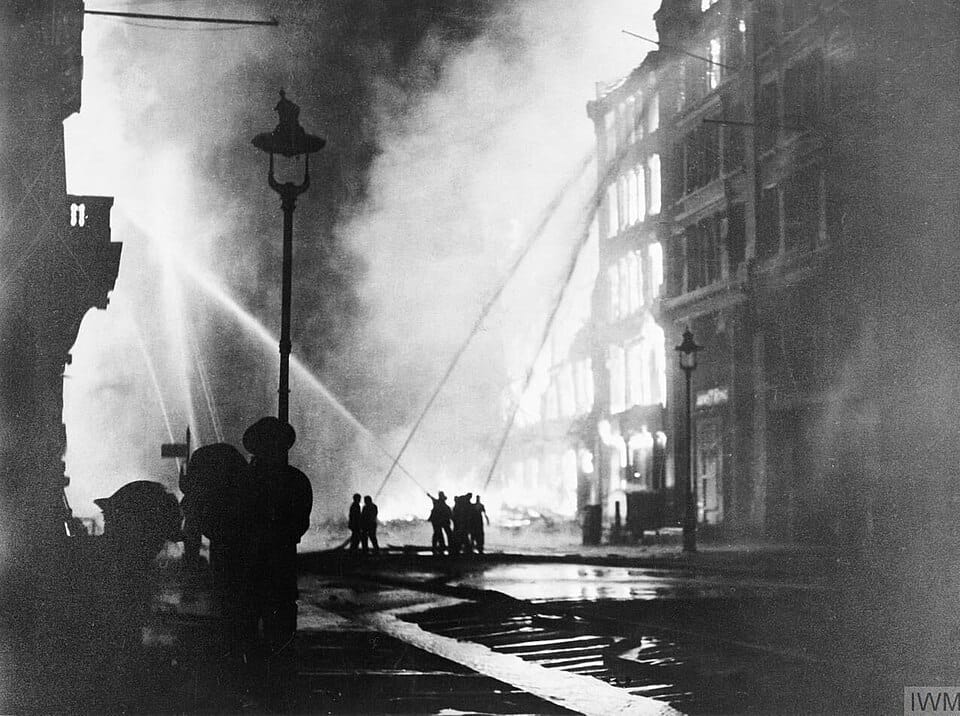
Of course, the Blitz (with the definite article) was the German bombing campaign of London and other British cities between the defeat of the Luftwaffe in the Battle of Britain and the German invasion of the Soviet Union. The Blitz lasted from September 1940 to May 1941.
There are lots of other metaphorical uses of blitz that flow from the World War II term. Blitz chess makes its appearance by 1942, as reported in the 5 April 1942 Hartford Courant:
Postal number two tells of the fourth annual banquet of the Deep River Chess Club […] After dinner, the evening was devoted to “blitz” chess interrupted for twenty minutes by a blackout test.
And of course there is its use in American football, where a blitz is a play where defensive backs charge the opposing quarterback in an effort to disrupt a pass play. From the San Diego Union of 27 December 1962:
I guess Green Bay is a pleasant place but I’d hate to live in a town where football is the only topic of conversation. Even the women in Green Bay are so knowledgeable about the sport they amuse themselves at cocktail parties drawing up draft lists for the Packers; and they casually toss off such trade terms as “red dog” and “blitz.” A violinist or chess player wouldn’t have much to talk about in Green Bay.
So while the meaning of blitz has evolved somewhat over the years, it still remains close to its violent roots.
Sources:
Avery, G. E. “Conn. Chess League and Club Notes.” Hartford Courant (Connecticut), 5 April 1942, A5/1. ProQuest Newspapers.
Bartlett, Vernon. “Foreign Correspondent.” Listener (London), 26 January 1939, 189/2. Gale Primary Sources: The Listener Historical Archive, 1929–1991.
“‘Blitz Flu’ Hits England, Mild Variety of Malady.” New York Herald Tribune (European Edition, Paris), 1 January 1940, 3/2. Gale Primary Sources: International Herald Tribune Historical Archive, 1887-2013.
Bouverie. “Newmarket’s Wealth of Racing Talent.” Daily Mirror (London), 15 March 1939, 28/2. Gale Primary Sources: Mirror Historical Archive, 1903–2000.
“European Climax in 12 Months.” Malay Mail (Kuala Lumpur), 8 April 1939, 3/4. Gale Primary Sources: British Library Newspapers.
“German Officer’s Secret War Papers Deride Hitler’s Spanish Objective.” New York Post, 9 March 1938, 1/1. Readex: America’s Historical Newspapers.
Green’s Dictionary of Slang, accessed 4 December 2025, s.v. blitz, n., blitz, v.2.
Hulton, Edward. “Resist German on Both Fronts.” Picture Post (London), 22 April 1939, 53/3. Gale Primary Sources: Picture Post Historical Archive, 1938-1957.
“London Rush to Buy Gold and Gold Shares.” Times of Malaya, 20 August 1938, 12/4. Gale Primary Sources: British Library Newspapers.
Murphy, Jack. “Who Wants to Live in a Town Where Football Is the Only Topic?” San Diego Union (California), 27 December 1962, a-15/1. Readex: America’s Historical Newspapers.
Oxford English Dictionary Online, 1972, s.v. blitzkrieg, n., blitz, n.
“Pardon Our Pride, but San Francisco Does Know How!” San Francisco Chronicle (California), 9 October 1939, 10/4. Readex: America’s Historical Newspapers.
“You Never Can Tell.” Daily Mail (London), 9 December 1939, 2/5. Gale Primary Sources: Daily Mail Historical Archive.
Photo credit: London Fire Brigade photographer, 10–11 May 1940. Imperial War Museum, image HU 1129. Wikimedia Commons. Public domain image.
