Bigfoot / Sasquatch
16 November 2026
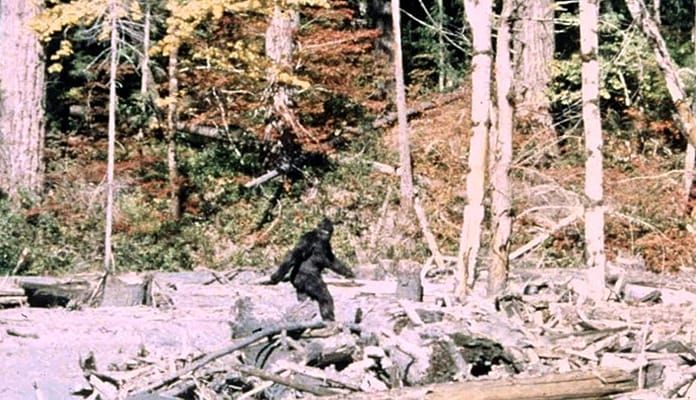
Bigfoot, or Sasquatch, is a mythical, giant, human-like creature who supposedly roams the Pacific Northwest of the United States and British Columbia in Canada, and sightings of similar creatures have been claimed elsewhere in North America. The name Bigfoot comes from the size of its supposed tracks. Sasquatch is a Salish word that translates as hairy man.
The name Sasquatch first came to the attention of the Anglophone world in an article in the 1 April 1929 issue of MacLean’s magazine. (Make of the date what you will.) In the article, the Sasquatch are not depicted as ape-like creatures but rather as an isolated race of giant Indigenous people who speak the Lillooet (Douglas First Nation) language. The article reads, in part:
CHARLEY VICTOR belongs to the Skway Reserve near Chilliwack. In his younger days he was known as one of the best hunters in the province and had many thrilling adventures in his time.
Did he know anything about the hairy ape-like men who were supposed to inhabit the distant mountains? Charley smiled, and answered that he had had a slight acquaintance with them. He had been in what he thought was one of their houses. “And that is not all,” said he. “I met and spoke to one of their women, and I shot…” But let Charley tell the story himself.
“The strange people, of whom there are but few now—rarely seen and seldom met—” said the old hunter, “are known by the name of Sasquatch, or, ‘the hairy mountain men’.”
In the article, Victor claims to have accidentally shot and wounded a Sasquatch boy, thinking he was a bear, and spoken with a Sasquatch woman in the Lillooet language.
The name Bigfoot first appears in October 1958, some thirty years later, in a series of Associated Press newspaper articles featuring a Northern California logger named Jerry Crew who claimed to have evidence of the creature’s tracks. The earliest one that I have found is from 5 October in the Seattle Post-Intelligencer:
Bigfoot, as the Bluff Creek people call the creature, apparently travels only at night. Crew said he seems fascinated by logging operations, particularly the earth moving that Crew does with his bulldozer hacking out new logging trails.
“Every morning we find his footprints in the fresh earth we’ve moved the day before,” Crew said.
CREW SAID Robert Titmus, a taxidermist from Redding, studied the tracks and said they were not made by any known animal.
“And they can’t be made by a bear, as there are no claw marks,” said Crew.
“The foot has five stubby toes and the strides average about 50 inches when he’s walking and goes up to 10 feet when running.”
The AP articles were published throughout the United States and widespread knowledge of the legend seems to stem from them.
Sources:
Associated Press. “Looks Human: Creature’s Footprint 16 In. Long, 7 In. Wide.” Seattle Post-Intelligencer (Washington), 5 October 1958, 9/6. Newspapers.com.
Burns, J. W. “Introducing B. C.’s Hairy Giants.” MacLean’s, 1 April 1929, 61/1. MacLean’s Magazine Archive.
Oxford English Dictionary Online, December 2008, s.v. Bigfoot, n.; 1982, s.v. sasquatch, n.
Photo Credit: Roger Patterson and Robert Gimlin, 1967. Wikimedia Commons. Public domain image.
