baby boom / baby boomer / boomer
27 November 2026
(For the naming of generational cohorts generally, click here. For the phrase OK, Boomer, click here.)
The Baby Boom refers to the increase in births in the US, Canada, and Europe following World War II, that is during the years 1946–64. And as those babies grew into young adults, they were labeled baby boomers and later simply boomers. But it was not the first baby boom. That term was coined in the late nineteenth century to refer to any spike in the local birth rate.
This generic use of baby boom begins in the fall of 1879 when the phrase starts appearing in a number of newspapers referring to a number of local births happening at once. The earliest of these that I've found is in Indiana’s Madison Daily Evening Star of 8 September 1879:
The baby “boom” has begun and in the Sixth ward there is joy. Mr. Will Davis and Mr. Ootson have both been presented within fifty-eight hours, with bouncing babies. There are at least four more Madisonians than there were on Saturday morning.
One wonders why the women, who did all the work, don’t get a mention.
Another, also from Indiana, is in the Evansville Daily Courier of 17 September 1879:
THE BABY BOOM.
A Walnut’s Street Crack Yesterday.
Yesterday was a gala day in the baby line on Walnut street, only five little bald-headed, red-faced waifs (some of them no balder or red-faced than their male progenitors) came to the front during banking hours.
There are many more examples from this cluster of uses to be found in the archives.
Of course, references to the post-WWII baby boom don’t come until the war is nearing its conclusion. The earliest that I’ve found is this United Press syndicated article from 4 February 1945:
The Commerce Department reported Saturday night that the Nation’s birth rate, which rose 30 per cent above prewar levels in the year after Pearl Harbor, now is declining and will stay that way until the end of hostilities precipitates another baby boom.
This, however, is not quite a use of the baby boom. It’s a prediction of another generic baby boom to come, albeit one considerably larger than the local neighborhood booms of the past.
We see the label with the definite article being applied in an 1 May 1946 article in Iowa’s Iola Register:
Dairy herds are declining.
Population has rapidly increased—about 8,000,000 since 1940.
The baby boom is creating a demand for milk out of proportion to population increases that will be sustained for several years.
Eighteen years later, as those babies, now grown, were heading off to college, they start being called baby boomers. A syndicated column on education of 28 January 1963 uses the label in a headline:
Baby Boomers, Grown Up, Storm Ivy-Covered Walls
A tidal wave of enrollment will hit the colleges in the next two years. We have been warned repeatedly that enrollments will double between 1960 and 1970. What has not been understood generally is that half of this 10-year increase in applicants will come in the 1963-1964 and 1964-1965 academic years!
And the clipped boomer is in place a decade later. From The Canadian, a magazine insert in Canadian newspapers, of 24 January 1976:
The young always go through a period of rejecting the parent generation’s values and structures, and the boomers did it more completely than ever.
Sources:
“The Baby Boom.” Evansville Daily Courier (Indiana), 17 September 1879, 4/2. Newspapers.com.
Chappell, W. E. “Now Is Time for Smart Dairy Farmer to Increase His Heard.” Iola Register (Iowa), 1 May 1946, 1/2. Newspapers.com.
Edmonds, Alan. “Force of Numbers.” The Canadian (newspaper insert). Toronto Star, 24 January 1976, 4/3. Newspapers.com.
Green’s Dictionary of Slang, accessed 28 October 2026, boomer, n.6.
Madison Daily Evening Star (Indiana), 8 September 1879, 4/2. Newspapers.com.
Nason, Leslie, J. “Baby Boomers, Grown Up, Storm Ivy-Covered Walls” (headline, syndicated). Daily Press (Newport News, Virginia), 28 January 1963, 11/2, Newspapers.com.
Oxford English Dictionary Online, December 2021, s.v. baby boom, n., baby boomer, n.; March 2004, boomer, n.3.
Shapiro, Fred. “Antedating of ‘Baby Boom’ (Post-World War II).” ADS-L, 18 October 2026.
United Press. “Baby Boom Over” (3 February 1945). Commercial Appeal (Memphis, Tennessee). 4 February 1945, 4/3. Newspapers.com.
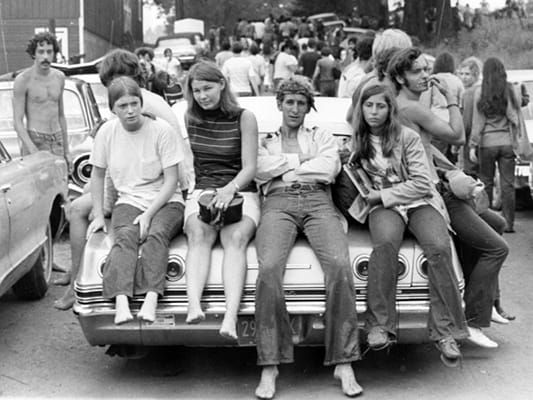
Photo credit: Ric Manning, 1969. Wikimedia Commons. Licensed under the Creative Commons Attribution 3.0 Unported license.
