airship
20 February 2026
As we use the word today, airship generally refers to a dirigible, but that specific usage became common only after 1900 and the launch of Ferdinand Zeppelin’s aircraft. The word appears as early as 1817 in reference to balloons and aircraft in general.
Airship is, quite obviously, a compound of air + ship. While the English word was formed within that language, it is preceded by the German Luftschiff, used in 1735 to denote a fictional craft and in 1783 to refer to the Montgolfier brothers’ balloon.
The first English use of the term is in reference to a failed attempt at a flying machine, which despite the claims to the contrary, seems to have only gained altitude by happenstance. From London’s Morning Post of 20 September 1817:
A country clergyman, in Lower Saxony, has been so happy as to succeed in accomplishing the invention of an Air Ship. The machine is built of light wood; it is made to float in the air chiefly by means of the constant action of a large pair of bellows, of peculiar construction, which occupies in the front the position of the lungs and the neck of a bird on the wing. The wings on both sides are directed with thin cords. The height to which the farmer’s boy (10 or 12 years of age) whom the inventor has instructed in the management of it has hitherto ascended with it, is not considerable, because his attention has been more directed to give a progressive than an ascending motion to his machine.
The Times of London of 11 October 1817 carried this item verbatim with the exception of the spelling with a hyphen and the term not being italicized: “air-ship.”
By 1823, the phrasal air ship was being used to refer to a balloon. From the Leeds Intelligencer of 11 September 1823:
The balloon would have been launched precisely at that hour, had not Mr. Green been requested by several respectable gentlemen present to defer it awhile, in consequence of the continued influx of company, which had not diminished at twenty-five minutes to four, when the signal of ascent was given and the balloon released. Nothing could exceed the magnificence with which, on bursting from her moorings, this air ship soured at once in a nearly perpendicular direction into the highest heavens.
And in 1850 we see the hyphenated air-ship being used to refer to something that approached what we would consider a dirigible, Ernest Petin’s design for a ligher-than-air flying machine. From the Paris correspondent of New York’s Ladies’ Repository of October 1850:
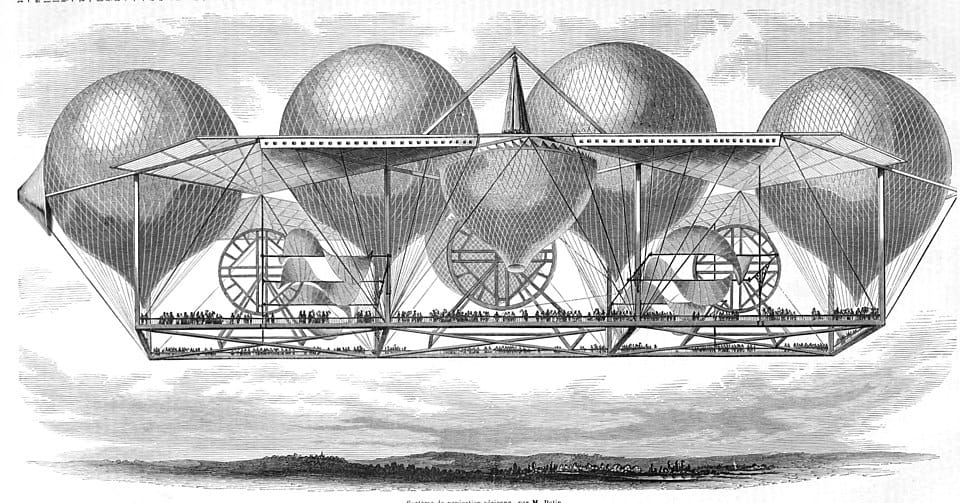
The subject of aerian [sic] navigation is exciting a good deal of interest here. A. M. Petin, member of the Academie Nationale de l’Agriculture and Commerce has been lecturing, for some months, in the Palais Nationale, upon the subject, and exhibiting models of an air-ship of his invention, which he thinks he can propel through the air at the rate of 20 to 120 miles an hour, and by means of which he promises to transport several thousand passengers, or a corresponding weight of freight, the air itself furnishing both the point of support and the motive power. This ship is an odd-looking machine of some 250 yards in length by 200 in width. It is open every-where, having neither top, bottom, nor sides, so that air may pass through every part of it without resistance. It is, in fact, like the frame of a bird-cage with all the wires taken out, and minus the floor.
Sources:
“Flying Machine.” Times (London), 11 October 1817, 2/4. Gale Primary Sources: Times Digital Archive.
“Letter to the Editor.” Ladies’ Repository (New York), October 1850, 317/1. Gale Primary Sources: American Historical Periodicals from the American Antiquarian Society.
Morning Post (London), 20 September 1817, 2/5. Gale Primary Sources: British Library Newspapers.
“Mr. Green’s Ascent.” Leeds Intelligencer (England), 11 September 1823, 3/4. Gale Primary Sources: British Library Newspapers.
Oxford English Dictionary Online, June 2008, s.v. airship, n.
Image credit: Unknown artist, 1850. Wikimedia Commons. Public domain image.
